Event-driven systems are hard to test with fixtures. A consumer that works on ten hand-written messages can still fall over on the thousandth, on a schema change, or on a burst. What a test environment needs is a steady, realistic flow of events on every topic the system consumes, serialised exactly as production does it. InsightDataGen's streaming commands produce that flow from the schemas you already have.
From schemas to a configuration
Most teams keep their event schemas in a folder or a repository. The config generation command reads that folder and writes a multi-topic configuration file: one entry per schema, with the topic name, the number of records per tick and the key settings, ready to edit. Files you do not want can be skipped with an exclude list. With the LLM option, and an optional file of sample values, the configuration can also carry realistic seed values for the generator.
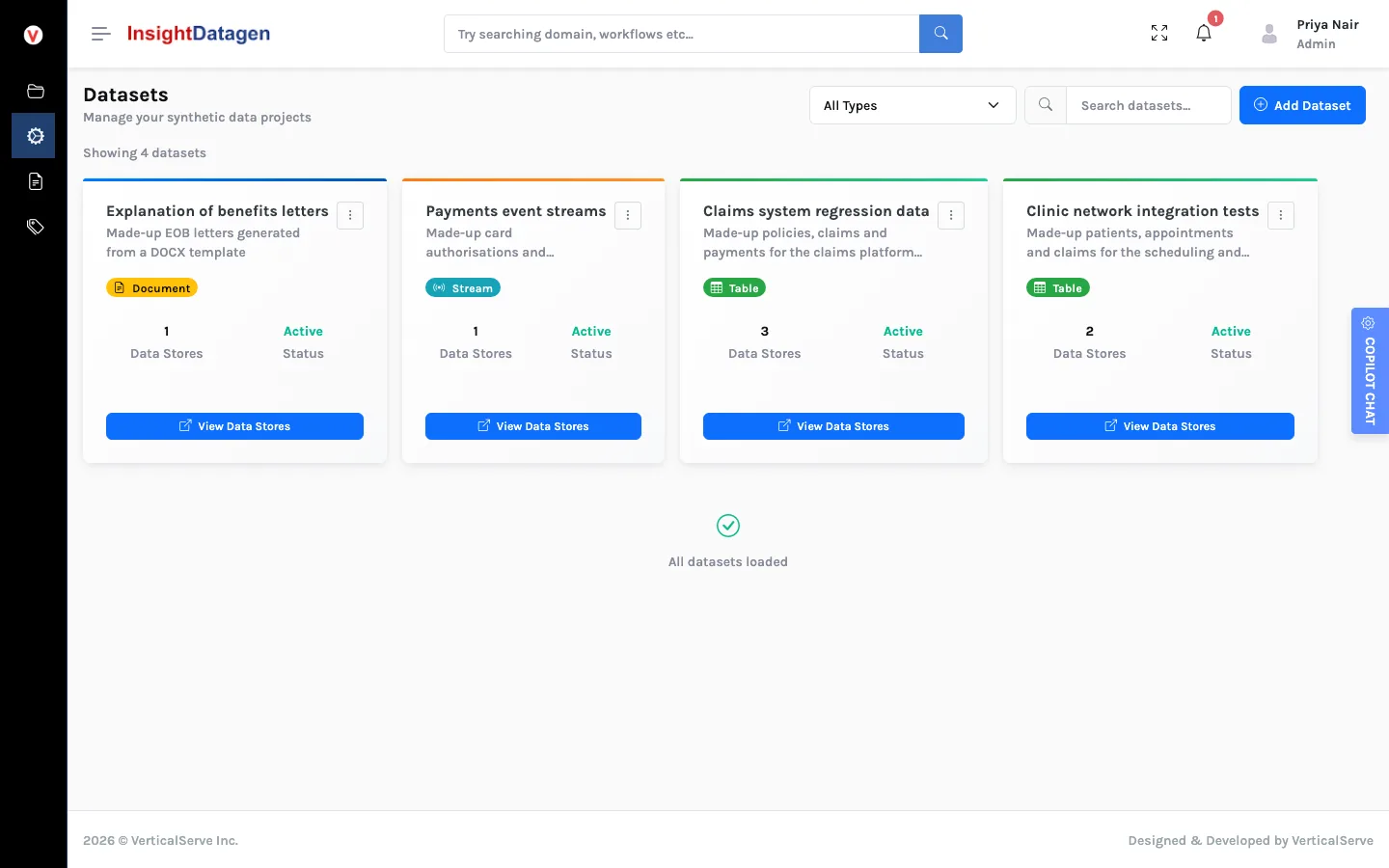
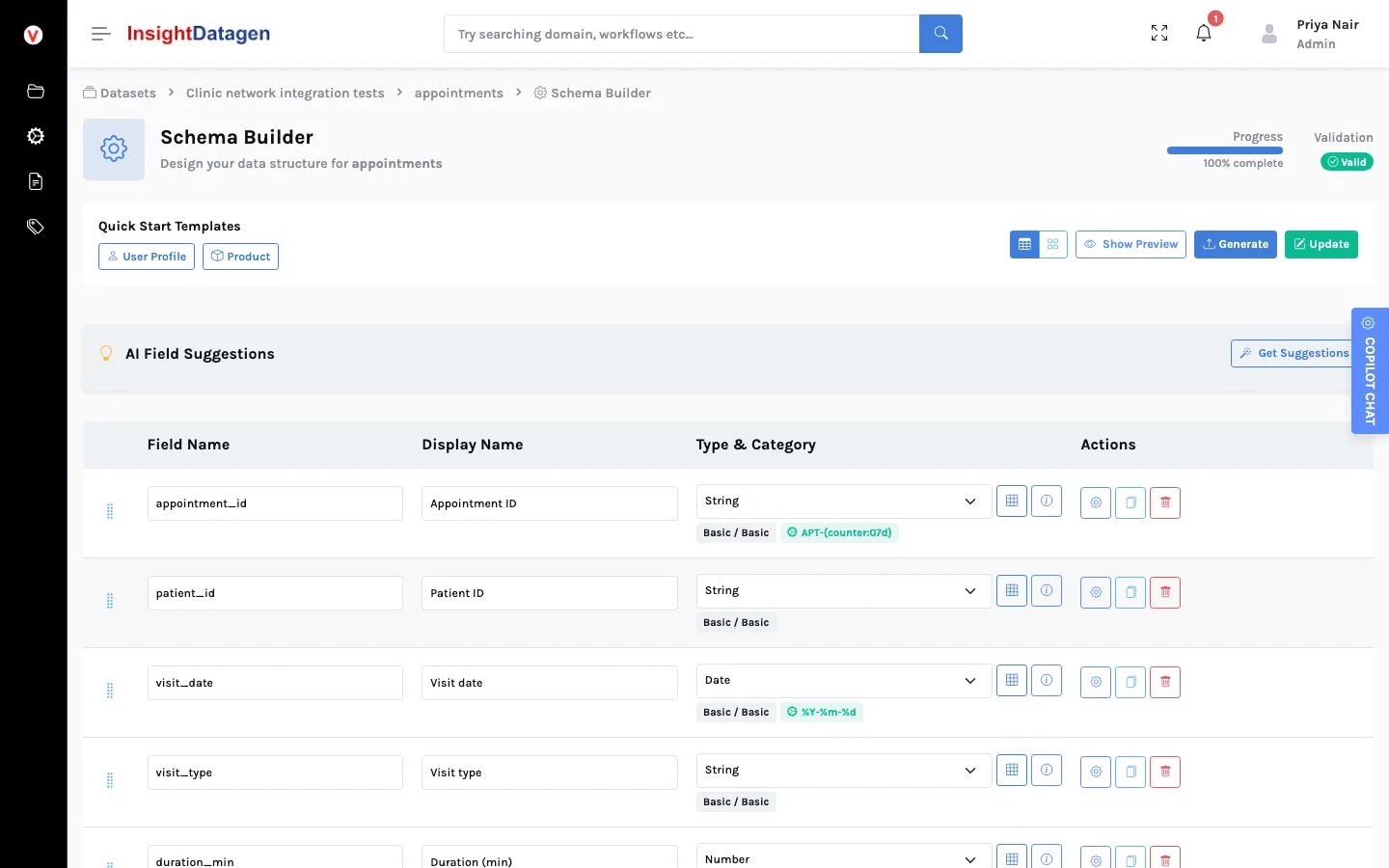
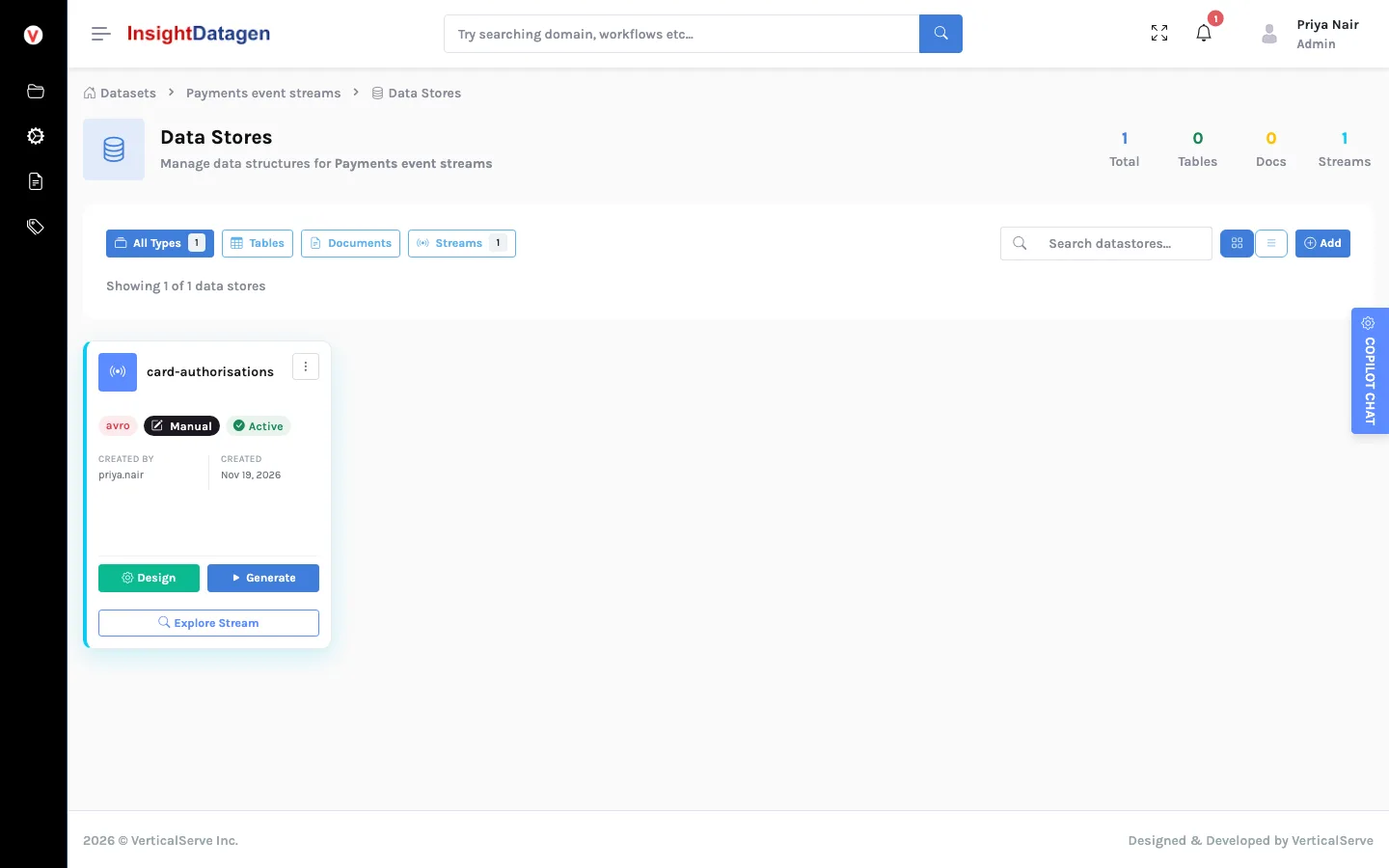
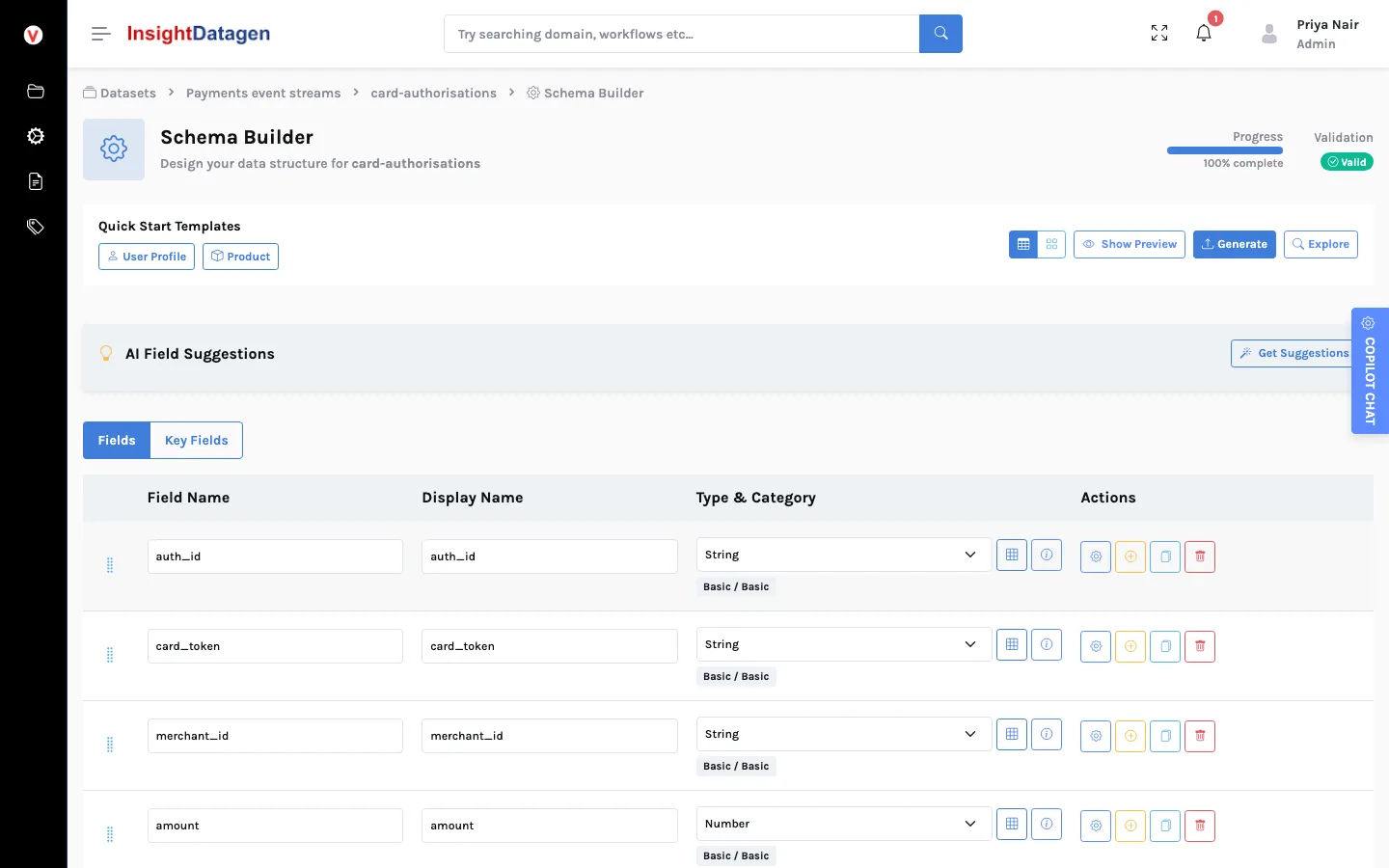
In the web UI, a stream is a data store of type Kafka stream created from a schema file. The fields are read from the schema, so an Avro record's fields appear in the Schema Builder ready to configure, and the data store card adds an Explore Stream action for reading back what was produced.
Streaming
The stream command takes the configuration and a credentials file, and produces records to every configured topic every interval seconds until max-time runs out. The credentials file holds the bootstrap servers and schema registry URL, plus SASL and registry authentication when the cluster needs them. Records are serialised in the topic's format (Avro, JSON or Protobuf) through the schema registry, so consumers deserialise them exactly as they would production events.
The two files you edit
The topic configuration
Under kafka_data.topics, each entry names a topic, the schema_file to generate from, its
format and num_records, the number of records per run (50 if you leave it out). Config generation sets the format
from the schema file's extension: .avsc (and .txt) for Avro, .json for JSON Schema, .proto for Protobuf. A file with
any other extension is rejected, which is the usual reason a config generation run stops halfway through a folder.
The credentials file
A kafka section with the bootstrap server and, when the cluster needs them, the SASL mechanism, security protocol, user name
and password; and a schema_registry section with its URL and, if required, basic-auth user info. Authentication is only
configured when those fields are present, so a file without them connects in plain text.
What "interval" actually means
The repetition is done by the container's entry script, not inside the producer: it runs the stream command once, sleeps for
interval seconds, and repeats until max-time has passed (5 and 60 seconds by default). Each run produces
num_records to every topic in the configuration. Two consequences for a load test:
- The real period is run time plus interval. With many topics or large batches, a run takes noticeable time, so the achieved rate is lower than records-per-run divided by interval. Measure the rate on the consumer side, not from the settings.
- Max-time is checked between runs. A run that starts just before the limit finishes, so the test ends slightly after max-time.
Load-testing a fraud-scoring consumer
Tomás leads the platform team at Larkspur Pay, a fictional card processor. A new fraud-scoring service consumes three topics (authorisations, merchant updates, device signals), each with an Avro schema in the team's schema repository.
- He runs config generation over the schema folder, excluding two deprecated schemas, and edits the file: 500 authorisations per tick, 20 merchant updates, 200 device signals.
- He streams to the staging cluster every 2 seconds for 30 minutes and watches consumer lag.
- For the burst test he raises authorisations to 5,000 per tick for five minutes.
The numbers here are the team's test settings, not a measured benchmark of the product. An illustration with a made-up company.
Choosing interval and volume
- Steady state: set records per tick and the interval to match production's average rate for each topic.
- Burst: raise one topic's records per tick for a short max-time and watch how consumers recover.
- Schema change: stream the new schema version to a copy of the topic and run old and new consumers side by side.
Topics and compatibility
The CLI also has a command that creates topics (one partition and a replication factor of one unless you say otherwise) and sets the
schema registry's compatibility for each topic's value subject to NONE. That is convenient on a scratch cluster where schemas
change daily, and exactly what you do not want on a shared one, where compatibility checks protect other teams' consumers. Use it only on
clusters you own.
Moving between Confluent and Redpanda
For teams that run Redpanda in test, the product ships a migrator configuration that uses Redpanda Connect to copy topics from a Confluent-compatible source cluster to a Redpanda target, so a test environment can be seeded from an existing one.
A first streaming test
- Collect the schemas for the topics your service consumes into one folder.
- Generate the multi-topic configuration; exclude anything deprecated.
- Edit records per tick per topic, and the keys if partitioning matters to the test.
- Write a credentials file for the test cluster only.
- Stream for a short max-time first; check one message per topic with your normal consumer before running for longer.
Questions platform teams ask
Can it reproduce production's exact rate?
Approximately. Set records per run and the interval from production's average per topic, then adjust after measuring, for the reason above. For an exact rate profile, a dedicated load-testing tool is the better fit; InsightDataGen's strength is realistic, correctly serialised records.
Does a failed run stop the test?
No. The stream command reports an error (a wrong password, an unreachable registry) and exits normally, and the entry script carries on to the next run. Watch the first runs' output: a test that prints the same error every five seconds for an hour has produced nothing.
Do consumers see real schema IDs?
Records are serialised through the schema registry, so consumers deserialise them the way they deserialise production events, against the registry of the cluster you point it at.
Next: document de-identification.